Welcome to Hannah Shaw’s Digital Teaching Portfolio for University of Florida VME6814 - Principles of Teaching for Animal Shelters.
Learning Styles
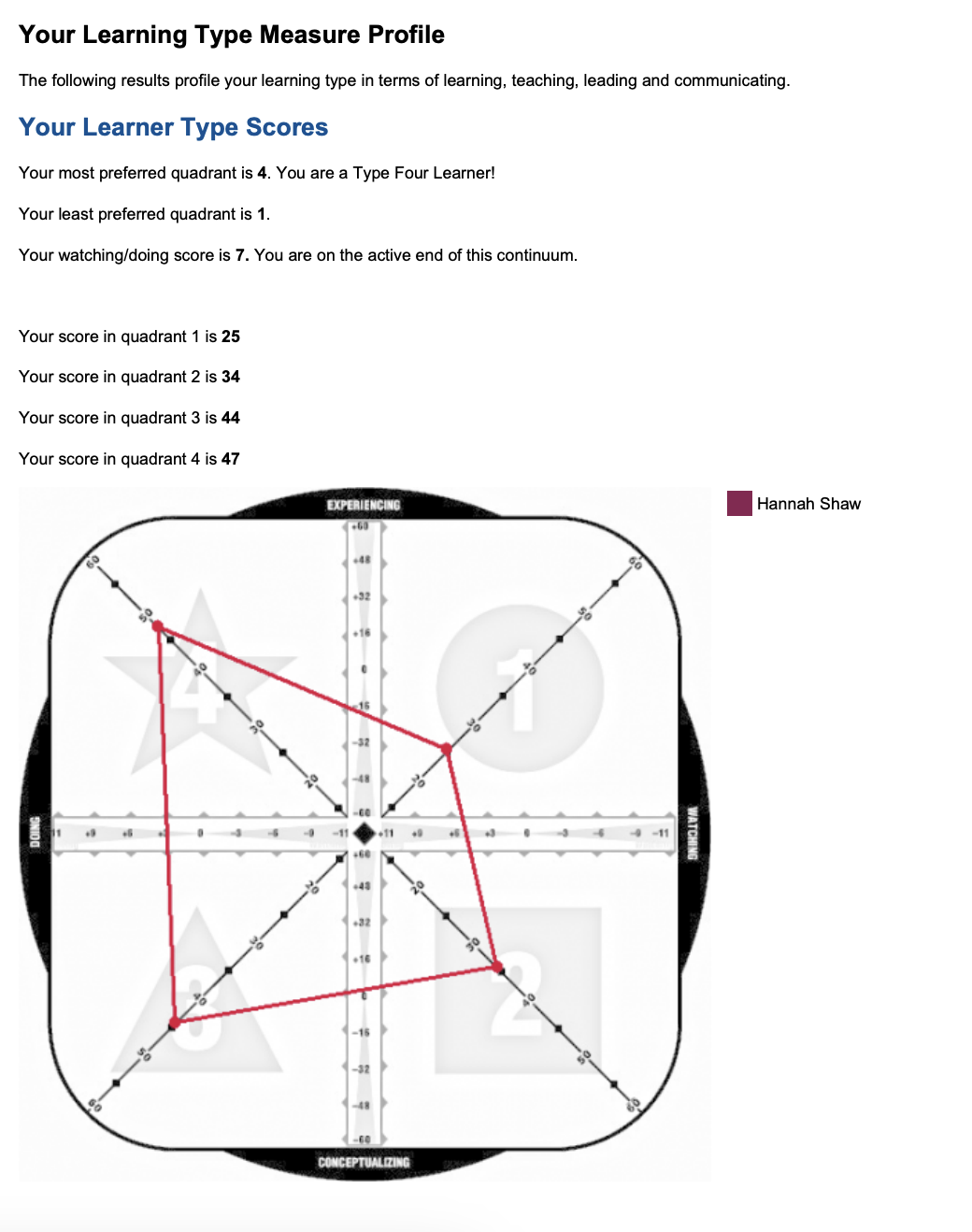
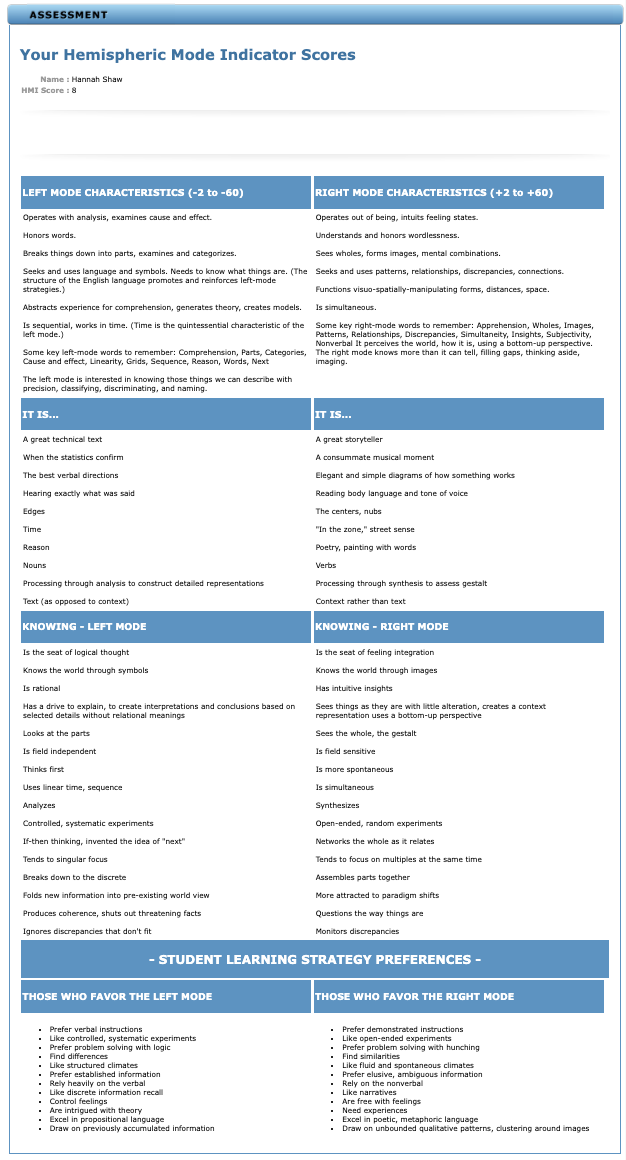
My LTM results showed that I am a Type 4 Learner. My HMI score was 8, which indicated a slight preference for right-mode thinking. I found these results to be an accurate depiction of how I tend to learn and work.
I believe that the pioneering nature of the specific subject area I focus on—advancing the care of neonatal kittens—may have informed the type of learner I have become. There is simply no formal learning setting that teaches the skills required for this work, and there is extremely limited research available to guide decision-making due to the historical underrepresentation of neonates in veterinary literature. Veterinarians frequently have little direct experience with the types of cases I work with, and there is often limited evidence-based guidance available. As a result, much of my learning has come through experience, collaboration, observation, and experimentation. It makes sense that I scored highest in the quadrant focused on innovation, adaptation, and application, as these have been essential to my learning.
I greatly enjoy the creative nature of what I do, but the reality is that creativity is often a necessity rather than a preference. When there is little research available and no established answer, the only option is to collaborate, gather information, ask questions, test ideas thoughtfully, observe outcomes, and continue learning. This process of learning, applying, observing, and improving aligns closely with the characteristics of a Type 4 learner.
My HMI score of +8 also felt meaningful. While the assessment indicated a slight preference toward right-mode thinking, I do not view myself as someone who relies solely on intuition or creativity. Much of my work requires balancing exploration with evidence, especially as my organization grows and seeks to influence the field through measuring outcomes and developing best practices that can be replicated by others. I enjoy imagining new possibilities and developing innovative programs, but I am equally motivated by evaluating results. I am as interested in the hard facts as I am in imagining a positive future that is yet unwritten. For that reason, the relatively balanced nature of my HMI score felt accurate.
Understanding my learning preferences will help me during this degree program, particularly because I haven’t had many opportunities for classroom-style learning in the field of animal welfare. I can sometimes become impatient when material feels disconnected from real-world use, and I can tend to move quickly toward implementation. I am hopeful that recognizing this tendency will help me to slow down, reflect, and engage more deeply with assigned readings and studies. I also found the discussion of emotions and learning meaningful. I am well aware that taking these courses during kitten season may lead to increased fatigue, which is why I’m starting my first semester slowly and making sure to observe what will be feasible for future semesters. It may be important for me to decrease my workload during particularly busy seasons. Being aware of these factors will help me approach learning more intentionally.
Learning about learning preferences, styles, and the impact of emotions has also made me reflect on my own teaching. One thing I am realizing during this module is that I do not always teach in the same way that I learn. Learning feels more like foraging and playing for me, while teaching feels much more directive. When I teach shelter staff about neonatal kitten program development, I often have a limited amount of time and an enormous amount of information I want to share. For example, in a two-hour presentation I might cover ten different programs to consider implementing for kittens, and twenty fascinating-to-me data points to consider. My instinct is often to maximize the amount of information I can deliver because I want participants to leave with as much new insight as possible.
This course is helping me realize that information delivery is not the same thing as learning. A shelter leader attending one of my trainings during kitten season may already be (understandably) exhausted or overwhelmed when they enter the room. While I may be excitedly presenting dozens of lifesaving program strategies, they may be silently wondering whether they could realistically implement even one of them. Since starting this course, I’ve started to notice that I often move quickly from one idea to the next without giving participants time to reflect, discuss barriers, or explore how the concepts might apply to their own shelter. Rather than criticize myself for this, I want to practice a growth mindset and realize what a gift it is to have something new to consider and work towards.
Going forward, I would like to create more opportunities for discussion, reflection, and problem-solving. For example, instead of only presenting examples of successful neonatal programs, I could ask participants to identify the biggest bottleneck in their own organization and work through possible solutions with their peers or in discussion with the group. The goal as an educator should not simply be to expose people to information, but to create learning experiences that help them feel confident, engaged, and capable of creating change in their own communities.