
Lesson Plan: Baby-Safe Biosecurity
Lesson Goal
To equip shelter staff and volunteers with practical, baby-safe biosecurity strategies that reduce the risk of infectious disease transmission among neonatal kittens between intake and foster placement, improving health outcomes and supporting positive foster parent experiences.
Audience and Format
This class is intended for all shelter staff and volunteers involved with intake, animal care, veterinary care, and foster care. This 55 minute class is designed for in-person instruction with large groups in a classroom setting.
Supplies Needed
Projector or television for powerpoint presentation
Glo Germ
Box of gloves
Clipboard and pen
Sample supplies: stuffed kitten, scale, pee pad, blender bottle, kitten bottle
Printed images
Lesson Plan
Engage: Invisible Exposure Discussion (10 minutes)
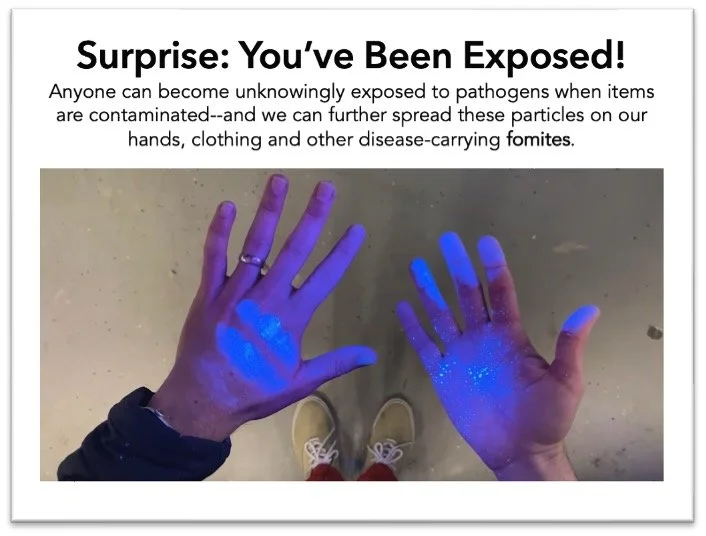
As participants arrive, they will sign in using a clipboard and pen covertly covered with Glo Germ. I will also intentionally handle the GloGerm and interact with materials throughout the introduction including my clicker, a stuffed kitten, and other items to model how contamination spreads unintentionally, but I will not initially reveal that I have done this.
Once participants have settled, I will open a discussion about neonatal kitten health and disease exposure. I’ll briefly introduce the concept of fomites: objects and surfaces that can carry pathogens from one animal to another. Learners will be asked to predict which items might be at risk of becoming contaminated during neonatal kitten intake.
I will then reveal how even one invisibly contaminated item, like a clipboard, can unintentionally spread these pathogens to the hands, phones, and other materials of each person in the shelter, potentially exposing vulnerable kittens to disease. I will show my own supplies, such as my clicker, under blacklight to demonstrate that even a well-intentioned person can become a fomite when unknowingly interacting with a contaminated item.
This stage is intended to create an “aha” moment while demonstrating that biosecurity is a systems issue, requiring all members of the team to work together.
Explore: What's the Worst that Could Happen? Activity (8 minutes)
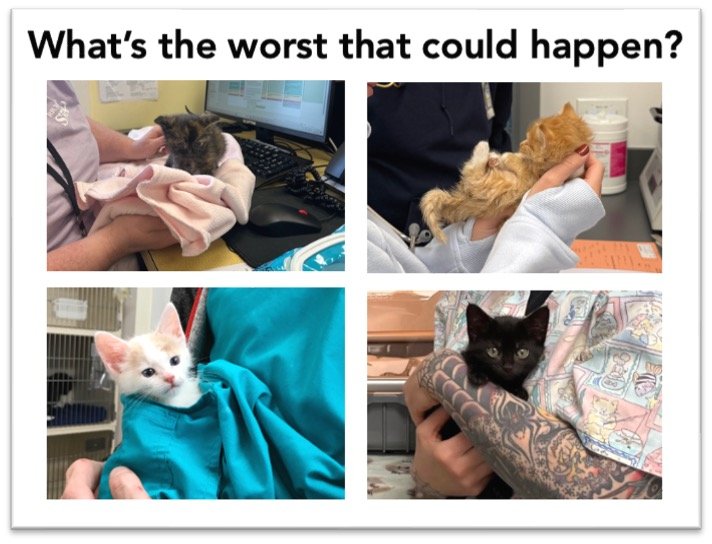
Learners will investigate how pathogens can move through shelter environments by reviewing photos and videos of kitten handling in shelters and veterinary clinics. For this activity, titled “What’s the Worst that Could Happen?”, they will be asked to imagine that each kitten is asymptomatic but shedding viral particles, and to identify potential fomite risks in each image such as hands, sleeves, countertops, pockets, phones, and hair. Learners will discuss how these particles could travel to another animal, and steps that could have been taken to mitigate this risk.
Rather than being told the correct answers immediately, learners will be encouraged to make observations and consider the possible consequences of biosecurity lapses.
This stage is intended to help learners begin building connections between handling decisions and health outcomes.
Explain: Baby-Safe Biosecurity Instruction (12 minutes)
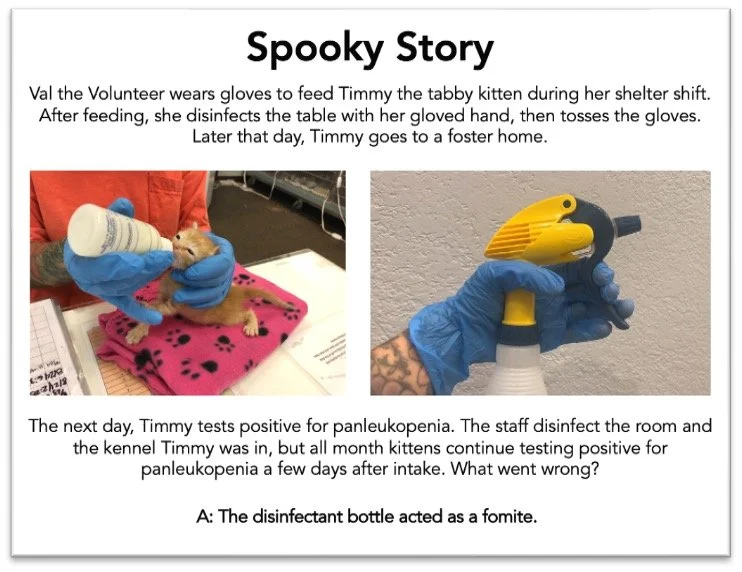
I will provide direct instruction connecting the observations made in the previous stages to baby-safe biosecurity principles for neonatal kittens. Topics will include neonatal kitten immune vulnerability, fomite transmission, enveloped vs non-enveloped organisms, ringworm spores, hand hygiene, glove use, barrier use, cleaning vs disinfection, and the length of time various pathogens can live on contaminated items and surfaces. Learners will review photos of glove use in shelter settings and discuss why gloves alone do not prevent disease transmission if contaminated gloves continue to contact clean items and surfaces.
I’ll end this stage with a series of “Spooky Stories” illustrating real-world situations in which biosecurity lapses contributed to disease outbreaks or poor kitten outcomes.
This stage is intended to help learners connect abstract concepts to real situations and their consequences, building motivation to improve their practices.
Elaborate: Practicing with Barrier Protection and Disinfection (15 minutes)
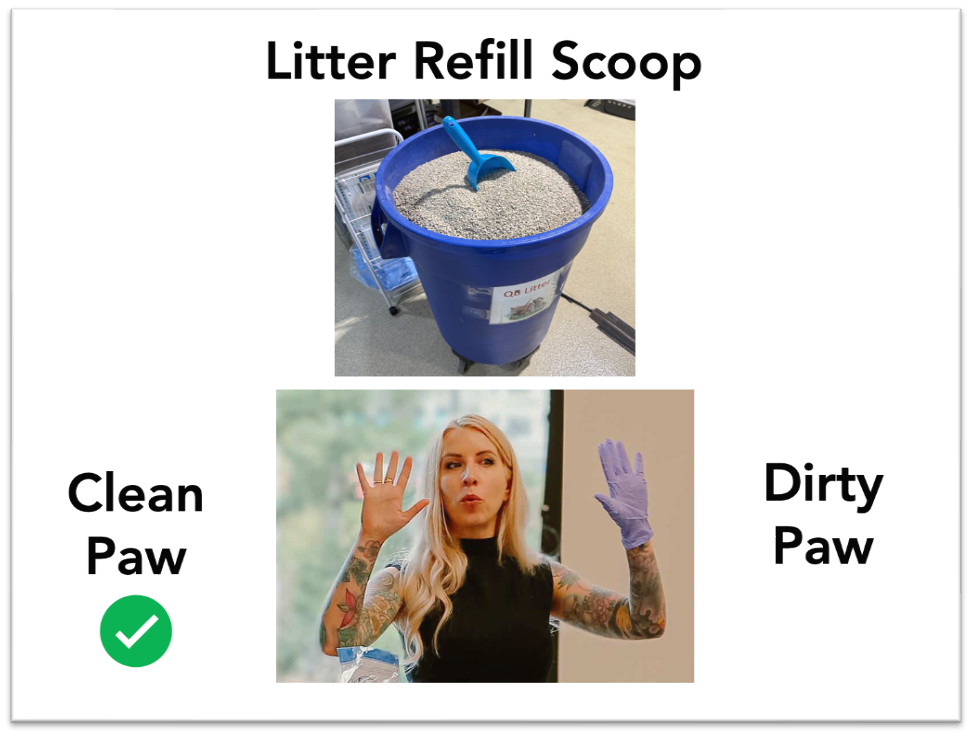
Learners will apply and extend their understanding through an interactive “Clean Paw, Dirty Paw” activity. Each student will be given one glove and will be asked to raise their “clean paw” (ungloved hand) or “dirty paw” (gloved hand) to identify which hand they would use to interact with various objects commonly encountered during intake and shelter care.
Following this activity, learners will break into three groups and be presented with a photo and scenario depicting a kennel, an examination table, or a feeding station that each need to be reset after use. Working together, they will determine which items should be discarded, protected with barriers, cleaned and disinfected, or left as they are before the next kitten uses the station. Groups will briefly share their reasoning with the class.
The purpose of this stage is to help learners begin to apply biosecurity principles by solving realistic shelter scenarios they are likely to encounter in their daily work.
Evaluate: Applying Biosecurity Principles (10 minutes)
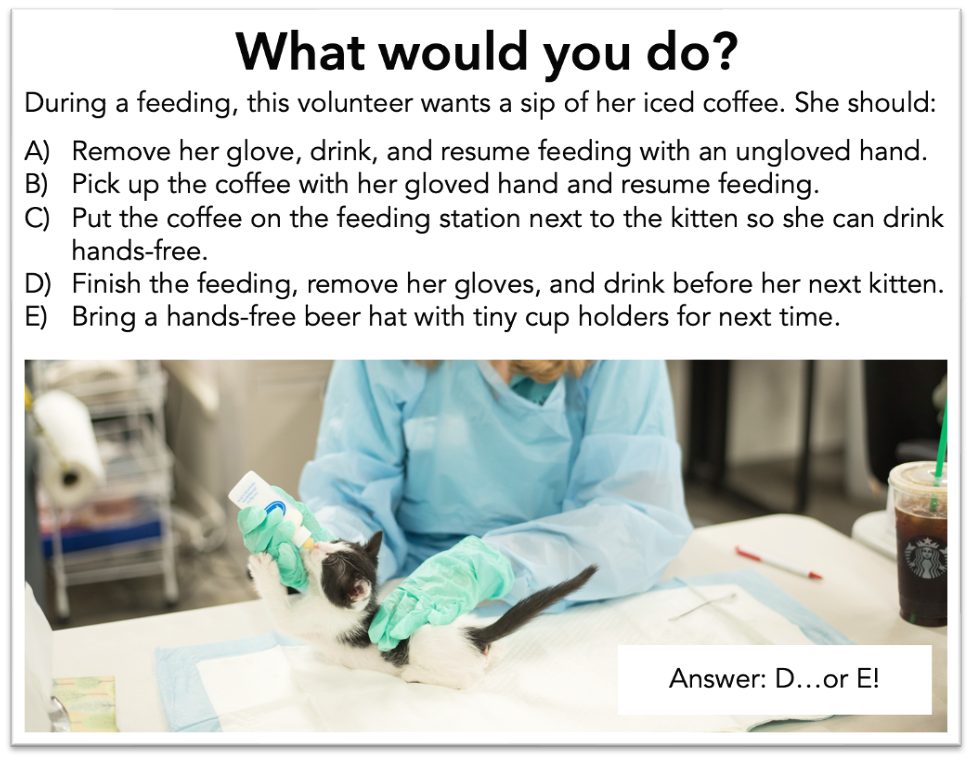
Participants will complete a pop quiz using realistic situations they might encounter while handling neonatal kittens. These scenarios will include a variety of complex issues such as a member of the public handing them a kitten in a laundry basket, needing to retrieve supplies while handling a kitten, preparing for fluid therapy, and even taking a sip from a coffee while working. For each scenario, learners will choose the best course of action to demonstrate understanding.
In closing, learners will participate in a brief “Invisible Wins” reflection. Each participant will identify one biosecurity practice they plan to implement and describe one positive outcome that might occur because disease transmission was prevented.
The purpose of this final stage is to evaluate learner understanding and encourage reflection on the connection between their biosecurity practices and the outcomes of the kittens they serve.
Learning Objectives and Assessments
Learning Objective #1: Identify potential fomite transmission risks during intake and handling.
Assessment: Learners will review photos and videos of kitten handling scenarios and identify potential contamination risks during group discussion.
Learning Objective #2: Demonstrate proper glove use during kitten handling.
Assessment: Learners will participate in a “Clean Paw, Dirty Paw” activity in which they must correctly decide whether objects are contaminated and should be touched with a gloved hand, or are communal/clean and should be touched with an ungloved hand.
Learning Objective #3: Demonstrate appropriate use of surface barriers, disinfection techniques, and item disposal when working with kittens.
Assessment: Learners will work in small groups to evaluate a mock feeding station, exam table or kennel setup and determine which items should be discarded, protected with barriers, or cleaned and disinfected between kittens. Each group will present their scenario and their reasoning.
Learning Objective #4: Apply baby-safe biosecurity principles during simulated intake and care scenarios.
Assessment: Learners will complete a scenario-based quiz and select the most appropriate biosecurity actions for realistic intake and handling situations.
Learning Objective #5: Explain how effective shelter biosecurity practices support foster success, reduce medical burden, and improve neonatal kitten outcomes.
Assessment: Each learner will reflect on one practice they intend to implement and describe one “invisible win” that might occur because disease transmission was prevented.
Learning Cycle
The 5E Learning Cycle allows learners to move from broad awareness of transmission risks to deeper understanding and ultimately the ability to apply solutions to real world situations. This approach is ideal for biosecurity training because many shelter staff and volunteers already have deeply ingrained habits and assumptions about kitten handling. By allowing learners to observe and investigate contamination risks before receiving direct instruction and opportunities for hands-on application, this model is more likely to lead to meaningful change that improves practices and leads to better outcomes for vulnerable kittens.